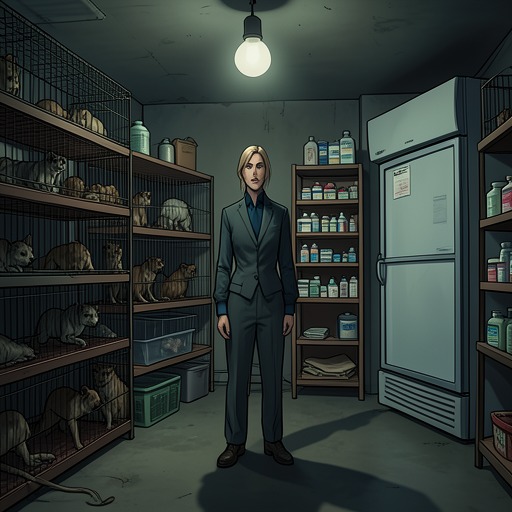
Elizabeth Stuart
Kay ScarpettaElizabeth Stuart is a well-established dermatologist whose practice connects several apparently separate strands of the investigation. She treats Terri Bridges, provides medical care to Oscar Bane, and employs Juan Amate, the man later identified as a disturbing link to the animal shop and the criminal network surrounding the case. Stuart’s role is not that of a central investigator or perpetrator, but her records and testimony help transform private medical details into investigative evidence.
Professional Identity and Practice
Elizabeth Stuart is described as a dermatologist with a large, reputable practice and more than sixty employees working across four locations. Her patients include Terri Bridges, who has visited her for years, and Oscar Bane, who went to her for laser hair removal and other painful procedures. Stuart’s professional standing makes her an apparently reliable medical authority, while the scale of her practice also creates the conditions for people on the margins of her organization to pass through without becoming personally known to her.
Her relationship with patients is governed by professional confidentiality. When Kay Scarpetta reaches her by telephone at the St. Regis, where Stuart is staying under the name Dr. Oxford, Stuart immediately refuses to discuss her patients. The refusal establishes a boundary that Scarpetta must pressure rather than simply cross: Stuart will provide information only when the danger surrounding the case becomes impossible to ignore. Her guardedness is therefore both an ethical professional reflex and an obstacle in the investigation.
Connection to Oscar Bane and Terri Bridges
Oscar Bane identifies Stuart as the dermatologist who treated him on East 79th Street. He says that Terri recommended her and that Terri had been visiting her for years. This detail places Oscar and Terri within the same medical sphere without proving that Stuart knew about their intimate relationship or any criminal activity. It also gives investigators a concrete route into the otherwise private routines of both characters.
Stuart’s connection to Oscar becomes more significant when Scarpetta discovers that Oscar recently received a prescription for eszopiclone from her. He began using the medication in early October for insomnia and renewed the prescription twice, most recently on December 27 at a Duane Reade pharmacy. The timing matters because Scarpetta notices that the dates on Oscar’s medications correspond to the period when his mental deterioration began. Stuart’s prescription does not by itself explain that deterioration, but it anchors it in a documented medical chronology.
Juan Amate and the Hidden Network
Stuart’s most consequential revelation concerns Juan Amate, a part-time or auxiliary worker associated with her practice. She says that her staff includes temporary workers, trainees, cleaners, and people who answer telephones or summon doctors, and that one man works for both her practice and a veterinarian. She knows him only slightly and does not regard him as an employee working exclusively for her. This institutional distance explains how a person could gain access to medical workplaces without becoming part of Stuart’s trusted professional circle.
Stuart recalls that Amate had something to do with a pet shop and had given puppies to members of her staff. He once offered her a small Chinese dog for her birthday, a puppy with hair only on its head, tail, and paws. The animal looked malformed, trembled, and coughed. Amate’s card made the grotesque joke that Stuart could tell people she removed dogs’ hair too and was a canine dermatologist. Stuart disliked the gift and returned the puppy, but her account leaves her convinced that something harmful may have happened to it afterward.
Her description of Amate becomes darker when she explains that he likes giving injections and is skilled with needles and blood drawing. She supplies his name, Juan Amate, while admitting that she does not know whether it is his full Spanish name. She also says that he had worked in her Upper East Side practice for roughly three or four years and was not permitted to enter while she was treating a patient. The limitations of her knowledge are crucial: Stuart has allowed investigators to identify a suspect’s professional access and habits, but she cannot provide a complete biography or account of his conduct.
Narrative Function and Significance
Elizabeth Stuart embodies the precarious boundary between medical care and investigative interpretation. Her practice produces useful records, including the prescription that helps date Oscar’s decline, yet her first instinct is to protect patient privacy rather than assist the police. The story therefore presents her neither as a negligent accomplice nor as an all-knowing expert. She is a professional whose limited attention to the people moving through a large medical organization has unwittingly placed her near the case’s hidden machinery.
Her testimony also widens the meaning of bodily treatment in the narrative. Laser hair removal, medication for sleeplessness, injections, blood drawing, and the bizarre treatment of animals all become connected through the figure of Juan Amate. Stuart’s ordinary medical authority is set against Amate’s misuse of clinical techniques, showing how the same instruments and skills can signify care in one setting and control or violence in another. Through Stuart, the investigation moves from Oscar’s prescriptions and Terri’s dermatological history toward the larger discovery of a network in which professional access, concealed identities, and bodily vulnerability overlap.